

by Oli Anderson, Transformational Coach for Realness
Creative Status is a podcast about using creativity as a vehicle for improving your life by deconstructing ego, integrating the shadow self, and designing and manifesting a real life.
Every episode explores how the creative process can help you GROW REAL by moving towards wholeness in yourself by making the unconscious conscious.
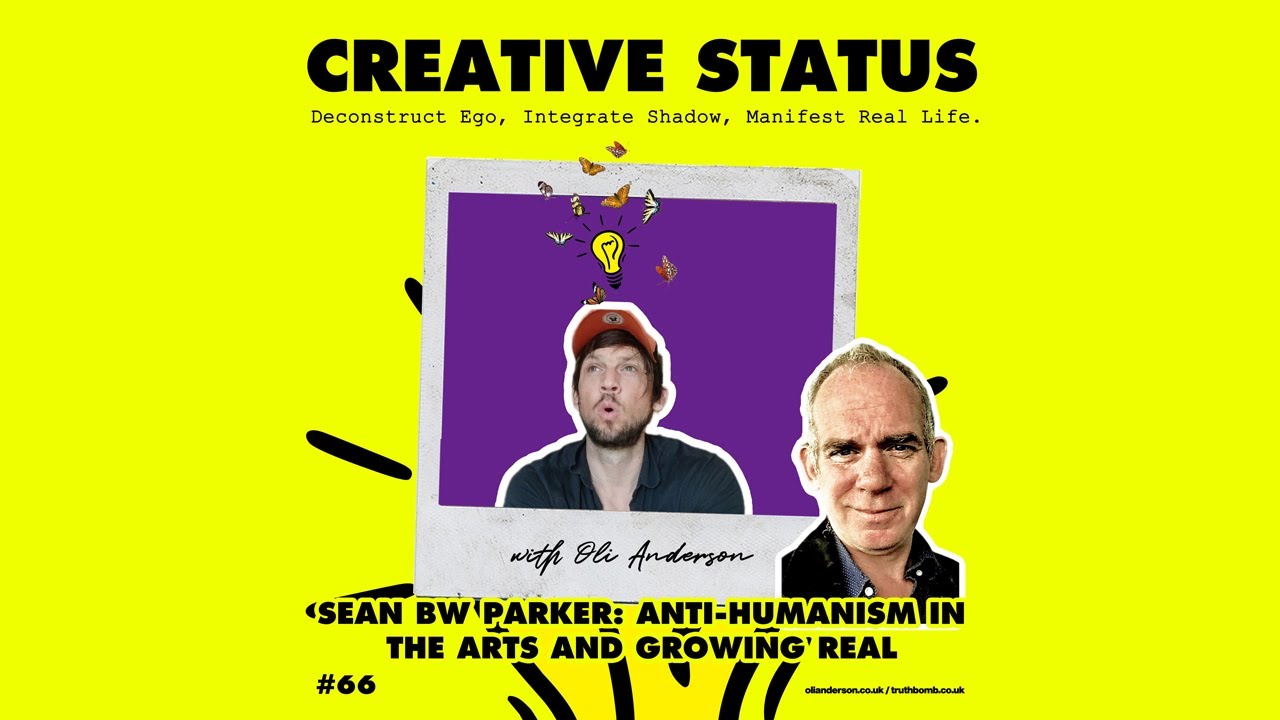
Prepare for a thought-provoking episode of Creative Status as we dive into the complex intersection of art, politics, and truth with writer, artist, and musician Sean Bw Parker.
In “Anti-Humanism in the Arts and Growing REAL,” Sean, a British artist, musician, and writer, leads us through a compelling conversation on how politics can obstruct the creative process, often causing art to become a shield against truth rather than a beacon uncovering it.
In-Depth Conversation: Join me (Oli Anderson) and Sean Bw Parker for a comprehensive discussion on cancel culture, creativity, and freedom of speech.
Explore the intricate psychology behind the left/right divide in modern society, unraveling the complexities that impact our creative expressions.
Navigating Cancel Culture: Sean delves into the challenges posed by cancel culture, exploring its impact on the creative landscape and the broader concept of freedom of speech.
Discover how artists navigate these tumultuous waters, striving to remain authentic while facing external pressures.
Psychology of the Left/Right Divide: Uncover the psychological underpinnings of the left/right political divide and its influence on artistic expression, challenging us to reevaluate our approach to truth and authenticity.
Creative Status: Where Truth Confronts Politics in Art
Join us for a conversation that transcends boundaries, challenging the norms of the creative process.
Tune in as they unravel the intricacies of anti-humanism in the arts, inviting you to question, embrace, and grow REAL in the pursuit of authentic creative expression.
Stay real out there,
Oli Anderson
—————————–
Leave a voice message to share your thoughts and to be (maybe) featured on future episodes of the podcast: anchor.fm/creativestatus
Episode Links:
Sean on X/Twitter: https://twitter.com/seanbwparker
Sean on LinkedIn: https://www.linkedin.com/in/seanparker100/
Creative Status Links:
The Creative Performance Transformation Lab: olianderson.co.uk/creativeperformance
Follow me on Instagram: instagram.com/olijanderson
My YouTube channel: youtube.com/olianderson
Get my books on Amazon: amazon.com/author/oli
7-Day Personality Transplant System Shock for Realness and Life Purpose: olianderson.co.uk/systemshock
Free one hour creative workshop to take your creative brand or project to the next level: olianderson.co.uk/creativeworkshop
Free 90-Day Journal Challenge: olianderson.co.uk/journal
The Law of Attraction for Realness (mini-course): olianderson.co.uk/lawofattraction
Anti-Humanism in the Arts & Growing Real (Show Transcript)
This podcast is about unblocking yourself from self-hypnosis and social conditioning
Intro
Oli Anderson: Oh, hi there – Oli Anderson here. You’re listening to Creative Status. This is a podcast about growing more real, i.e. unblocking yourself from all of the self-hypnosis and social programming and conditioning that you may have been through in life has caused you to become fragmented and divided within yourself.
That sounds like quite a lot, but we’re chipping away at, it day by day, piece by piece, so it’s not quite as painful as it sounds. The whole idea of the podcast is that the creative process is a vehicle for allowing you to do that, because as you follow your creativity wherever it wants to take you, you’re going to become more human in the sense of being more whole, more connected to life, more connected to the way of things.
That is the theme of today’s podcast interview, talking to Sean B. W. Parker, who is a writer, an artist, and a musician. He writes a lot about cultural politics. So this is the most political episode of Creative Status so far, which, was kind of interesting for me, because normally I don’t talk that much about politics, even though a lot of the crazy, unreal bullshit going on in the world that stops us from being real is political.
So it was quite interesting for me to explore all the stuff that I usually talk about on the podcast through that lens. Ultimately, if I was going to sum this conversation up, we’re talking about how art, ah, ultimately, is about making us more human, or it should be in the ideal sense. It allows us to confront the truth about ourselves, about other people, about the world.
But as the world goes crazier and crazier about identity and attaching to ideas of ourselves or about ourselves instead of the experience within ourselves, we found ourselves in this culture where people are actually kind of scared of the truth, and it causes them to hold back and to hide behind their creations instead of to use those creations to uncover and unmask themselves, so that’s the abridged version. It’s a really interesting conversation.
Sean, I’m really, grateful that you reached out and that we, had this conversation, because it’s made me think about things, more deeply than maybe I would have done. So, Sean, thank you to you, everybody else. Hope you enjoy this episode. It’s probably going to piss some people off but just remember, “The truth will set you free, but first, it will piss you off and make you miserable”. Love to say that.
Anyway, here we go. Thanks a bunch. Boom.
Interview
Oli: Oh, hi there, Sean. Thank you for joining me on today’s episode of Creative Status. This is going to be one of those episodes I feel that could go all over the place, but we’re going to try and bring it down to earth, I suppose, by talking about humanism in the arts.
Before we get into that, do you feel like introducing yourself, letting people know what you’re all about, and also sharing, if you feel like it, what you want to get out of this conversation that we’re about to embark upon?
Sean BW Parker: Yeah, sure – thanks ,Oli. It’s great stuff. I’m Sean B. W. Parker. I’m a writer, artist, musician, and, I write quite extensively in cultural politics, which is what sort of brings me here, speak to you today and I’m very interested in the subject of anti-humanism. Humanism, what’s being done by council culture to the arts in general right now.
Oli: Wow. Okay, that’s awesome. So let’s get right into it. I was thinking about this before we started recording, and I think ultimately, the greatest art, the realest art, or creativity in general, is something that allows us to be more human. It allows us to express our humanity and all of the good and bad things about that to the greatest extent possible so we can understand ourselves, understand each other, and ultimately accept life to a deeper degree and enjoy this crazy human condition a bit more.
So, for me, humanistic art, or art that supports humanism is about that. It’s about helping us to be more human. But there is a kind of thread within our culture which you’ve just alluded to around cancel, culture and all this kind of stuff that is anti-human in the sense that it blocks that expression. So that’s how I’m seeing this. As we segue into the actual conversation, how is your philosophy aligned with the way that I’ve just kind of tried to sum it up before we dive into it.
Sean: Yeah, well, I completely agree with that, essentially. And there are certain reasons behind that and because of it, which are to do with political strategy and political science, of course, if you point this out these days, you get called a conspiracy theorist or far right or whateveris the slate of the day.
And, that’s the problem, because artists used to be the people to point out these things, but now they’re just chucked into, the parallel universe of, whatever’s going on, which isn’t necessarily a bad place to be. It’s just new territory to be discussed.
Oli: Yeah. So I suppose if we break it down to the simplest components, ultimately, this definition that I’ve given of art, has been something that can help us move towards a closer relationship with ourselves and each other. And life ultimately means that art, or creativity, ultimately is a vehicle for uncovering the truth in our relationship with ourselves and allowing that truth to help us have a deeper, connection to other people.
Because only if you’ve got the truth can you build something that’s real – that’s just a logical thing in my understanding of things. Like, if you don’t have the truth, then whatever you’re building with your life is just floating on some castle in the sky and it’s destined to crumble.
So it seems like there’s kind of a contradiction between that fundamental aspect of creating some kind of creative thing, versus the way that the world is relating to truth. And maybe a simple example is comedy.
I think that the reason comedy is so important is because comedians ultimately tell the truth, or they make jokes that allow us to understand the truth to a greater degree. But because people are so sensitive these days, it seems a lot of comedians are, finding themselves in situations where they can’t just joke about whatever they want to joke about, and they have to pander to the crowd more than they may have used to do.
And even though it seems like in the short term, maybe it’s nice, we should be sensitive and all these kind of things, I personally believe if we take the truth out of the equation or we censor our relationship with the truth, then it’s actually holding everybody back.
And even though I’ve just used comedy as an example, it seems like the culture is becoming truth averse. Like we all want to hide from the truth. It seems collectively, at least, and the art and the creative works that have been produced are kind of reflecting that.
So I’m throwing a lot at you, but if you do agree with that, how do you think we ended up in this situation? And more importantly, I guess, what can we do about it?
Sean: Yeah, well, absolutely. Especially when it comes to comedy – if, music is the highest start to which all others, aspire, as has been said before, which I’m up for, because everybody understands how much that will hit you faster than anything else comedy is meant to be the most honest art form, coming from other human beings truths put in a way which is accessible to as many people as possible, and that is what they’re meant to do.
If you get on a stage in Britain, that’s the one place historically you’ve been able to say anything like speaker’s corner, anything that’s in your mind in a way that you can’t necessarily elsewhere.
The freedom of speech isn’t as absolute as people think, but a comedy stage is. That’s been taken away because of postmodernism, sadly. And because post-modernism starts with subjectivity – “Your truth is the truth, as is mine”.
And we have to get those two not even to agree, but to exist in their own space, which is absolutely fine as long as it’s 8 billion agreements, which isn’t politically, doable. And we’re realizing it now. We’re struggling with it and comedy humour, what’s the term is an injury of the left, unfortunately. I don’t want to put it to left right, too much, but it tends to be on the left.
People say that humour is like a defence against the truth or something. That if you laugh at something, it’s because you’re hiding something which is massively, offensive, really. I’m not taking offense, but you know what I mean. It’s offensive to the nature of humour itself and possibly being English, because we’re incredibly cover everything with humour in order to get by. And that’s just been tossed out with everything else, isn’t it?
Oli: Yeah, I love what you just said about postmodernism. This is something that I’ve realised through quite a lot with the work that I do. So ultimately I ramble and I rave and I say a lot of words, but ultimately, I’m always talking about the same thing. And what I’m talking about is, if we want to be happy in life to the greatest extent possible – I don’t believe true, lasting happiness is possible because something is always going to happen – but, anyway, if we want to feel good, if we want to be content, if you want to move towards our potential and feel like a real human being who is moving towards wholeness, then we need to embrace reality, ultimately, or the truth.
We need a foundation of some truth that is going to, allow us to build on solid ground, ultimately. And to do that, it’s often going to ask us to step away from our ego, away from our way of identifying and all of the fragmented ideas that we have picked up in our relationship with ourselves to try and stay in the same. The truth is that life keeps changing.
And, in relation to what you said about postmodernism, I have found quite a few people over the years have disagreed with me when I’ve ultimately said that the truth just is what it is. There’s an absolute truth.
And the postmodernists, they always argue exactly like you kind of posited earlier that I can have my reality or my truth. You can have your truth that they’re all equally valid, that they’re all equally worthy of respect, and that we basically are allowed to just attach to some interpretation of life that feels right to us, which kind of, of course, is within our rights, but we’re allowed to attach to that and nobody else can disagree with it because if they do, they’re going against, our whole worldview and understanding and blah, blah, blah and it’s deeply offensive.
I think that view is actually holding people back. And when people say that I have my truth and you have your truth, what they’re really saying is I have my interpretation because of my own emotional bullshit. You have your own interpretation because of your emotional bullshit. And we’re both clinging to them so we can try and stay the same.
Ultimately, the truth, I believe, is that there’s three sides to every story. There’s my side, there’s your side, and then there’s the truth itself. And only if we understand that can we transcend or let go of our attachment to our interpretations so that we can keep evolving, and we can keep flowing and we can keep moving with life into a deeper appreciation and deeper relationship with life. If we get caught up in this postmodern view – sorry, I’m rambling loads – but if we get caught up in this postmodern view of just clinging to the interpretations like our whole lives depend on them, then we’re stopping ourselves from actually living a real life.
And to me, the truth is always going to be a threat to our interpretations because the truth itself doesn’t need defending. It just is what it is. Nobody has ever argued about the truth. I say all the time, people can only argue about those interpretations.
And if you’re arguing about it, you basically clinging to it for some underlying emotional reason. And that is ultimately the problem. I think it’s why comedians are having this problem. We’re talking about why art, has become super ideological. It’s because people are trying to defend their little interpretations of life as though it’s the truth itself. And so there’s that inner conflict between clinging to something that’s not actually real and constantly trying to deny the truth, which never goes anywhere by masking it behind identity and all that kind of stuff.
So I’ve just thrown loads of stuff at you. That was my big rant for the day. I think I’ve had too much coffee. But how does that fit into, I guess, the way that you’ve experienced things and the way you’ve seen life.
And again, what can we start doing about it, in your view, to help people realize that actually stepping away from these interpretations and not clinging to little snippets of sense and meaning that we’ve just pulled out of our asses, basically, not clinging to that stuff is actually the way to bring us all together, but more importantly, bring us closer to ourselves so that we can actually do that.
Sean: Well, I think you’ve just, kind of hit on a brilliant solution to people’s angst about the postmodern issues that they’re going through in culture, because it’s sort of killing people, spiritually, and they don’t know that because they’re so basted within it.
You’ve just pointed out post politics and post postmodernism, we obviously need a better term from that. But you’re talking about the truth, and we do know what you mean, because you’ll have some twat who turns around and says, yes, but my truth is more important than, oh, yeah, and you’ll go, no, but he’s talking about the thing he’s talking about not talking about from him.
And once people get the good meaning behind what you’re doing, and I mean that in the terms of it has a purity inside it, you’re not trying to hurt anybody. Once people get that and they get that, you’re talking past politics, which is about accidentally hurting others in favour of your own, principle. You’ve gone beyond that, which is the most positive, beautiful thing you can do.
And that’s language of Russell brands and the Joe Rogan’s and the people that are apparently controversial right now, but they’re not because they’re talking what you basically did in their own styles, aren’t they? But they haven’t even gone to this third truth. It’s beyond that, too. So, you’ve hit the nail on the head, and it would be good if we get other people to hear that a bit more.
The only thing we need to do is uncover the truth and then live the truth
Oli: Yeah. So ultimately, then, let’s break it down into the divide between the left and the right, just in a kind of objective way and how people tend to attach to certain points of view as a way of resisting the truth itself. I really, really, truly believe, and I’ve seen it so many times, in my own life, by coaching clients.
The only thing we need to do, regardless of our political persuasion, is to uncover the truth and then live the truth. But for whatever reason, as we go through life and we pick up emotional stuff and we get programmed by society to stop believing in ourselves and all this kind of thing, we become truth resistant.
And changing our lives as human beings, no matter what we believe, actually is about stepping beyond the beliefs that we’ve picked up and attached to as an extension of our ego identity so that we can start flowing with life in this kind of spiritual way you alluded to, instead of just forcing life through what we think we need to know to feel that false security of identity and ego.
So, this is me kind of riffing, but we need to flesh this out a bit. I think when I look at the left, right divide, the left and the right, ah, are both attached to different interpretations of the truth, but they’re coming into the same truth from a different attachment, if that makes sense.
So what I mean is, in general, the human experience, I think when we’re talking about moving towards the truth, is about transcending an unhealthy relationship with our biological wiring. So nature basically, and with our social programming, so nurture.
So ultimately, to live a real life and to get into this flow of the truth, or whatever you want to call it, we have to walk the bridge between nature and nurture in general. When it comes to left versus right, it seems to me the people on the left are super, super attached to the nurture idea.
They believe that if you can just create the right ideological system, then you can basically shape human beings into being literally anything, a magical unicorn, I don’t know, a fairy, literally anything – because ideologically they believe, or, conceptually, that the nurture, which is always a conceptual thing, non-experiential thing, is always the truth.
I personally think that’s bullshit. I think no concept is fully real. And the more attached you become to a concept, the worse your life is going to be. But that’s how the left seems to me. The right, on the other hand, they’ve gone super deep into the nature thing. I believe that nature does come before nurture because nature sets the tone of our lives and the cards we’ve been dealt and what’s possible physically and biologically and all that kind of stuff.
But at the same time, we can transcend an unhealthy relationship with our obsolete biological wiring. We don’t have to be purely driven by instinct and natural impulses and all that kind of stuff, because we can use our ability to think and use concepts to refine our relationship with that, and to make sure that we’re not just living in the short term, but we’re living in the long term, which means we grow into what wholeness and truth and all that kind of stuff.
And so for me, if I look at the political pantomime that is unfolding in the world, you get people that are attached to one or the other, in a very extreme case, as is now unfolding in the culture as a whole. What I think we need to do is to see that both of those have value, but only if you’re using them in a real way. And a real way, for me, means that you’re taking the information from either nature or nurture to move towards a deeper relationship to truth, the absolute truth that I’m talking about, which is really just the experience of flowing with life, realising that we can’t control everything, m navigating uncertainty and chaos so that we can find that, stronger foundation by letting all of our bullshit ideas fall by the wayside.
So again, I’m ranting at, you. Sorry, it seems like I’m just ranting my way throughout this podcast. But what do you think about that? Is that true? And if so, how do we learn from it?
Because I really think I’m not a centrist, but I think left is bullshit, right is bullshit, and we need something more real, and that involves facing ourselves and becoming very aware of this natural, creative flow that is in all of us towards the truth.
Sean: Yeah, well, I think you’re sort of talking towards what everybody is looking for, and it’s not a rant at all. It’s a very good explanation about, what people actually want without probably being able to verbalise it – it’s post left, right.
If we go to like 150 years ago, 200 with Marx on the left, for example, just for easy examples for people not to dissect too much. And Nietzsche on the right from Friedrich Nietzsche – the individual with Nietzsche versus society of Marx and these two opposing things, industrial revolution and commercial revolution and tech revolution, for good reason, to get the rights of people up to where they have been.
And with the Marxist thing, that hasn’t been a success in many countries and the point is that’s done in the sense that loads of people are out of poverty. Not everybody, but loads. And it’s not a thing you can drive forever. So they decided to spanner it all into identity, to try to give that the same currency as economy.
And it doesn’t, it’s just very dangerous, actually, people didn’t expect it to be as dangerous as it has been, but it’s turned out to be very harmful in the way that you would see the psychology of, the impact that has on people when they put in their X (Twitter) bio, “I’m a, trans lesbian of colour, from Mozambique, and I went through child slavery”.
So is that how you want me to treat you, or shall I treat you as the much more complex human being that you actually are? And so what you’re doing is, trying to go to this universal truth that I think that will be very controversial to the militants out there. But it’s not controversial to me because, I’m a humanist in the pure term. And you’re absolutely right.
A cow isn’t going to understand your version of universal truth, but a person speaking Chinese is, I think. I genuinely think. I don’t know what Mr. Chomsky, who’s also a Marxist, would think about that with his theory of universal grammar. But I think he might be inclined to somewhat agree with you.
Oli: Yeah. So how do we start to move in this direction? Because I really think now that what we’re now talking about is just true. I work in my coaching practice to help people basically come around to this way of thinking. And as soon as they do, they’ve got this more solid foundation that I keep referring to. And they can get better results in relation to whatever path they put themselves on in terms of a vision for their life and all that kind of thing.
But in order to transcend that left right dichotomy – that is unreal – we need to reconfigure quite a lot of things in relation to the way we relate to ourselves. And again, you can bring it back to the standard way that the left and the right tend to think.
So in general, I think those on the left, when they’re getting super extreme about it and been militant, they basically think that the government or society at large, some external body, is responsible for their happiness.
On the other side, the people on the right, they kind of take on board an extreme responsibility. In many cases, they’re super independent. They’re outside the system. They’re responsible for their happiness. That is very true – ultimately, we can’t be happy without taking responsibility for our lives. But in both cases, I think it can become too extreme.
And so if you’re really far on the left and you think that everybody else is to blame for your problems, you’ve basically got a personality disorder, I think because you’re just projecting everything outside, and you don’t have any internal locus of control where you’re guiding your life in alignment with your values and your intentions.
The other side of the coin, though, is if you go too far into taking responsibility for your life. Then you become a control freak. And you’re not disordered necessarily, but you become neurotic. You think you can control everything. So the extreme consequence of both of these views is that you’re detached from reality.
And again, there’s a middle ground which leads to the truth I have found, and it’s where you need both. And so the way that I often describe this is you have to sacrifice yourself to create yourself. And so all that means, or a more simple way, is enemy. You’ve got to make your values valuable to others.
And so ultimately, we’re living in a way where we’re sacrificing ourselves in the sense of finding a way to serve the world that’s aligned with our true values. So, for example, with this podcast, right, like, I value creativity. That’s why I got this podcast. This allows me to create, goals for myself and a sense of purpose where I am making my value of creativity more valuable to other people. So I’m sacrificing myself.
That sounds dramatic, but all I mean is I’m using my time, I’m growing, and so on and so forth. I’m pushing beyond my identity and my ego to just put myself on this path of kind of sharing this kind of stuff. I know that sounds really kind of grandiloquent, but at the same time, I’m creating myself by doing that. And so, I’m not just blaming everybody else for my problems, I’m still taking responsibility for my problems.
But I’m not seeing myself as an independent entity in the world or a super dependent entity in the world. It becomes more about interdependence. And so, for me, interdependence is the way into the truth, because the bottom line is, the truth is about wholeness, and that means we’re all connected to each other.
And so whether you’re on the left or the right, if you see yourself as some ego construct that exists as just a separate thing, the ego is the illusion of separation. I think then you can never get to the truth. And so ultimately, there’s this middle ground – if you want to call it that -where you’re merging the strengths and weaknesses of the human being, the darknesses and the light to become more real. Because ultimately, you mentioned Nietzsche in a way, what Nietzsche said, right? It’s about being beyond good and evil, beyond good and bad, beyond judgment. It’s just real.
If you attach yourself to a judgement, you become unreal
And ultimately, if you’re attached to any of these, political polarities that we’re talking about, you’ve attached to a judgment. And as soon as you do that, you become unreal. So it’s about transcending that by creating a purpose and a path for yourself in order to get there.
Sean: Yeah. Ah, that was an excellent, sentence there: “If you attach yourself to a judgment, you become unreal”. That could be our subtitle. It’s fantastic. Absolutely right.
The problem is that society being the market that it actually is, we think it’s about us as humans and we know we’re mistaken. What we’re doing right now is the art of thought. But society operates on the basis of market, and that is a state of adolescence, because they’ve realized that the rock and roll, spirit of the most profitable things that ever happened. Because you’re getting people in the state of angst and energy and liveliness, which are all great fun and exciting, and it’s good to go through them, which is why I’m pro people being able to take drugs if they want, and I’m anti-censorship.
People should go through all that. And once you have, it’s probably not a good place to stay for your entire life because you’ll die early or you’ll get fucked up, which is worse. So it’s like, your thinking has gone to a place of maturity. There’s nothing wrong with that. And that’s not, the problem that the left attaches to the idea of maturity, because the left thinks that maturity is tired, conservative, stale.
There’s nothing off those thoughts at all. It just means calm balance and a place beyond the extremes. What you could do about it? I mean, what I would do, if I were you, to properly write a book, do a podcast and keep talking to decent people. I think you might be doing that. Keep doing it just as I do in the painting and music and whatnot.
When it comes to the ego, there’s nothing wrong with having an ego the size of Mr. Russell brand or, the Donald Trump. Two massive egos of the world. They’re doing what they do. The problem is with Trump is that he’s still attaching the politics to it, because that’s what he does, that’s his nurture.
Brand seems to be post-addiction, going to his own truth and all that, and angry about the system. I’m not angry about the system. I don’t know about you. I’ve been used to it since I was 17. I know what they’re doing. It’s just really cool that people are now able to discuss it – maybe it’s because I’m in my…I’m not, ah, the fire brand about it. But I don’t think I ever have been.
I’m aware of hypocrisy. I know what they do. It’s just, trying to help other people understand that art at its truest form and people’s love. If you want, like, the conversation we’re speaking now, is that the love of thought and truth?
There’s very little irony in what we’re doing here, because that’s what happens when you talk about reality. And, people have a deep thirst for that. That’s the population of, the popularity of, Mr. M. Lex Friedman, for example, and Stephen Pinker. These kind of, you know, I keep chucking names at you, but it’s only for our listeners to have something to hang it on but these people do actually go towards what we’re talking about, and there’s a huge desire for it, and we’re on the right lines and just sort of keep to it.
Oli: I guess when I think about the systems, I don’t get angry. Like, I agree with what you said. I think the system is just other people. And I know there’s an element where with a kind of hierarchy that there’s a system built around there are going to be people at the top, and then people become more corrupt at the top because there’s nepotism and all that kind of stuff. But in general, society is just other people.
And you can’t be angry at this huge vortex we’ve created of our own unconscious volition. I think all you can do is just see that, like with our individual lives, the situation that we find ourselves in often is just, more often than not, is just a consequence of all the choices we’ve made previously.
And so the system that we have now is ultimately just a consequence of all the choices that we have made collectively throughout human history. And I don’t get angry about that because I think it gives us power. I don’t think we need to go out there and start burning down the Houses of Parliament or have a massive revolution or anything like that. We just need to look at ourselves and to ask ourselves where we’ve been real and where we’re not.
And what I’ve found is, even though I think the world is kind of fucked up and the system is broken in many ways and inspiring, we can still have a good life by being real in the way that I’m talking about, which just means uncovering the truth and then living the truth.
And, paradoxically maybe the more of us that do that individually in our own lives, the more leverage we have over the system collectively, if that makes sense. Because ultimately, when we figure out this stuff out… I’m, making it too complicated.
If you look at the world, it is the Gandhi thing, right? Like “Become the change you want to see in the world”, blah, blah, blah.
Most people, when you say, “Right, what do we need to change about the world?” They’re going to start talking about other people. They’ll say, “Right, well, Donald Trump needs to not be president again, and they need to sort this out and they need to sort that out. And I’m sick of all the leftists, I’m sick of all the people on the right, blah, blah, blah, blah”.
No one ever says, “Well, actually I need to take a deep breath. I need to chill the fuck out, and I need to stop attaching to my views that I think are the truth and to just let go and see what I can learn. I need to shift from a position, of certainty to one of uncertainty”.
Like that is true wisdom, right? All I know is that I know nothing. And if I can align myself with that, then probably I’m going to learn something that is going to make me happier. And then if we go through this process individually, then the world has to become more real.
And so I’m, making it complicated, but my view is if we work on this stuff in our own lives, walking that middle ground, transcending good and bad and judgments and unreality that comes with it, that is our contribution to making the system better in the long term. And obviously, if the system gets really bad, like really bad, like where we’ve got a tyrant or something like that, or like a fascist regime or whatever, that’s just making us all live in fear, then maybe there’s a breaking point where we need to resort to violence.
But ultimately it’s not that bad yet. And I don’t think it will be. And I think as long as people wake up from this slumber of just been so attached to their opinions and just thinking that the bullshit they believe is the truth and wanting everyone else to believe the same bullshit, then the world can change and it’ll probably change quicker than people think. But maybe that’s naive, I don’t know. But I think that’s the most logical thing to focus on because that’s the only thing we have control over, our relationship with ourselves.
Sean: Well, absolutely. I can remember at the end of the last century when I was at university and everyone’s talking about this new strange thing called the interweb. And, what’s going to happen is going to be the information century and China is going to rule the world and, well, okay, that information century it is. And here we are in the middle of it, discovering the new currency and warfare of info, which is what’s going on on X and everything else.
It’s better than bloodshed. I’m going to say that. I’m going to say that quite proudly. I’d prefer to be doing this and having what we’re having than, being a Gaza, for example, right now.
But I was just watching the COVID inquiry, on YouTube earlier on with Boris Johnson, trying to apologise for two years ago without telling the truth. And I had this chat in mind. And it’s like, part of me is going, the poor guy, because he’s just a right brain poet, just floundering in a political position there in Boris.
Everyone’s going, “You bad person. You took us into that place and the country did all…whatever was responsible”.
Your listeners are going to decide for themselves about COVID I’m not going to say anything. It’s like everybody’s got their ideas about the origins, but, the fact that we’re surrounded by lies, and those lies are communicated to us for reasons that we’re not aware of. And we can only, presume because we know about the real politic, which we’ve known about since Machiavelli and the ancient Greeks, what people will do to get things done and whether that’s for us to be a, race slave of humans with our alien overlords, you could never say no about anything.
I can’t see the point in speculating on that right now. But I can see Boris Johnson squirming at the thing because he thought he was entitled to be prime minister because of his own, as you might say, ego. And because the family nurture of a bunch of competitive Tories, in his family, encouraging him to be that did a couple of years, couldn’t get anything done because kept being stopped. And there he is, square B.
But I’ve also heard him recite the first chapter of the Iliad without a book in front of him in Greek. And it’s the most astonishing thing I’ve ever. You know, people have their goods and their bad and their skills, and that’s where he was happy and good. But for some reason, because of ego, he thought, “I need to be prime minister of England for a couple of years”. That’s the love of art I’ve got coming out at the end of what we’re on about here.
Oli: No, but actually, it’s super relevant, because the consequence of people being super attached to their political views on either side, or any views, actually, about anything, the consequence of being super attached to that stuff is that eventually the attachment starts to weigh you down and it becomes something that you identify with. You get the ego situation that we keep talking about, but if you’ve got the ego hanging over you and holding you back, then there’s always going to be some truth about you hidden within the shadow self.
So, for Boris, as a textbook case, based on what you said, his ego was, for whatever reason, that “I need to be this great prime minister, and he was going to go down in history and be remembered, blah, ah, blah, blah”.
Massive anti-climax for him following that path. But actually, there is, an undercurrent of creativity and poetry and beauty and all these kind of things, even in Boris. And probably, like, if he wanted to follow that thread through and see where it led him, it would lead him to a greater expression of those sides of himself that he’s been denying, because have been hidden in the shadow behind his ego.
And, he would probably get better results because he’d be following something that is organically unfolding within him. And he would be happier as well, because he’s not forcing everything through this, egotistical idea that he’s picked up somewhere along the line and identified with.
And every single person out there who is hiding behind some political view to justify that the current version of their ego and the emotional bullshit that they’re trying to hide from every single one of them has something real like that hiding in the shadows.
That’s the travesty, really, of this, attachment that we have to points of view and information. Information. The reason we love it so much is because it gives us a sense of control. We feel like, “Okay, if we have concepts and theories and ideas, we can understand life”, but actually, life itself is chaotic, is constantly moving, it’s constantly evolving. And we can try and hide from that evolution behind information and points of view, and it will give us some short term comfort.
But in the long term, it’s exacerbating the angst that you’re talking about, because angst is just a gap or an existential void between what’s insiders waiting to come up from the shadows and what we’re actually expressing. And so, again, it comes back to this relationship with ourselves. That is the true solution, I think, to – I don’t want to say world peace, I don’t think that’s possible – but to a more harmonious world where people are, making sure that the gap between inside, inner, and outer is minimized.
And you can only do that by facing the truth, because for most of us, if we caught up in that ego stuff that we’re talking about, for most of us, in the shadow self is the truth. Our relationship with the truth is buried down there, and it’s always trying to surface. And so what we need to do is stop blocking it. And that applies individually and collectively.
There’s an individual shadow that we all have, but there’s a collective shadow. And actually, collectively, our shadow currently involves human nature, chaos, uncertainty, love, to some extent, joy, blah, blah, blah, blah. All of these things are down there waiting to come up. And one by one, I think we need to work on chipping away and let it re emerge. So Boris is a good.
Sean: You know, you’re kind of hinting towards this place to come, and I think that, if a lot of people aren’t there, then they’re going towards it. Having difficulties in life does tend to hasten this on a little bit. And almost all of us have had these difficulties which do help for absolute. And, the experience that Boris has had there, just for our easy example, would hopefully help him.
Everybody does deserve love, and they do, actually deserve the enlightenment that you’re speaking about as well, because you are talking about enlightenment. And it’s like he deserves that as anybody else does. Whatever they’ve done, Jesus and the John Lennon in me does say that whatever anybody has done, they do deserve that chance of enlightenment, too, and wherever that leads them, heaven, et cetera, who knows?
Oli: Yeah. I’m, so happy you said that, because ultimately, what goes up must come down. That’s what I always say, right?
Like, eventually you can live in all these castles in the sky, hiding behind concepts and illusions. And the ego, which just isn’t a big unreal illusion, you can only take it so far before reality or the truth comes sweeping back in and you lose those illusions. And it’s so true.
Like, in my life and in loads of people, the lives of loads of people I’ve known, hitting rock bottom has been the best thing that ever happened, because it’s exactly like you said, it brings the truth back into your life. When you hit rock bottom, you never lose anything real. You just lose the illusions that you were trying to fight to keep in place before the shit hit the fan.
And so, collectively, let’s say the worst case scenario, like, very dramatic for comedic purposes, I guess. Worst case scenario, society collapses. Everything just goes horribly wrong. And basically, it’s like a big reset button. We go back to ground zero.
When that happens, in this hypothetical example, we would all be asked to face our illusions. And when we do that down there at rock bottom, the only thing we could do is just see the futility of them, let go and start building something real. And the realest truth is, like you said, that we’re all worthy of love. The truth and love are basically the same thing.
Like, truly, that’s just how I’ve seen it. And so anything that keeps you from the truth, keeps you from love. And that’s why so many people are fighting for all these crazy views and opinions that they’ve got. They’re scared to love themselves. They’ve been conditioned to believe that they don’t deserve it. They’re fuelled or driven by shame and guilt and trauma, which is what keeps the ego in place in the first place – and social programming is saying that if you do love yourself is selfish.
But ultimately, whether you fly sky high and see the truth, or you hit rock bottom and you see it, it’s the end result: you’re worthy of love. And if you don’t understand that then you’re going to constantly be running around on the hamster wheel of fighting for all these crazy opinions and judgments that are holding you back from the truth.
Sean: You are correct.
Oli: So I’ve been running and raving at you for 40 minutes already. I feel like this episode should have been a few hours – but how would you sum up what we’ve talked about so far? I suppose, if that’s even possible. What is the main lesson from this conversation? And, if you have a website or something, can you let people know what it is so they can get in touch?
Sean: Yeah, no – much more interesting than how to get my stuff is our little 40 minutes content. It’s just wonderful our art is the thing, and even Boris doing his Iliad, is his art, and Mr. Trump’s manipulation of the media, in his way, is his.
And if you can see past your own ego and prejudices into the love that these people are trying to share, because the riches and stuff are not about that – it’s the person that they are. And that can be applied to everybody because these people are only lightning rods, aren’t they? Everyone can see people that they love and hate in them and that’s what they’re there for. There are gestures and, what you’ve been told, what we’ve been heading towards is this third place without any smugness or arrogance or. We’re better than that. It’s just going. It’s a place that you can see coming because this is unsustainable.
And, we’re only living at 75% at best, aren’t we? And we can be up to 95. I’m never going to say 100 because I’m not an absolutist. But we can be definitely to 95% of our capabilities, at least this century. Let’s see what happens, because there is always – I’ve been through terrible shit and I’m sure that you have too and our listeners – so it’s like that is in the pocket and there’s always things to do and as long as you keep your head on and, yeah, great stuff can come out of, the most difficult of circumstances, for sure.
Oli: Wow. So have you got a website or anything that people can go to?
Sean: Oh, yes, yes. Lovely. If people would like to, hit the Google and search Sean BW Parker. “Sean BW Parker”. And get my books there on Amazon – I’ve got the nine books up there of cultural theory and stuff like we’re talking. And, if you’re into the musical bent, then go to Spotify and do the same thing. They can get one of my six or so albums and if they’re into news, they can come to X, Twitter and, Yeah, it’s all under Sean BW Parker. I’ve got the same name everywhere.
Oli: Right, well, I’ll share some of the links in the show notes and a shout out to your music. I was watching it on YouTube. It was awesome. It was like a shoegaze kind of thing or something like that. But I was super into that – so, Sean, thank you so much. This has been a good one. Appreciate your time and, stay real out there, sir. Thank you.
Sean: You too, Oli. Brilliant stuff.
Join my mailing list and get access to a powerful 7-Day Course for REALNESS and Life Purpose (with dedicated workbook):


Personal Revolutions: A Short Course in Realness is a book designed to help you look at your life from the inside-out so that you can stop holding yourself back and go get what you really want.
It contains 166 practical ‘Revolutions’ for awareness and over 8,000 Self-Guidance Questions for you to uncover new insight about yourself, the world, and reality that you can translate into action and start building your real life on the realest possible foundation.

Trust: A Manual for Becoming the Void, Building Flow, and Finding Peace is a book about learning to return to your realness by cultivating trust in yourself and trust in life.
It contains practical exercises and dedicated meditations (Transformational Bridges) to take you DEEP in knowing yourself and life.
This book will answer many of the questions you have growing REAL and flowing towards wholeness. It covers everything from shame to addiction to the unconscious mind and synchronicity (and way more).

Shadow Life is an exploration of the human shadow and the hidden side of our personalities. It looks at the masks we wear, where these masks come from, and how we can take them off.
The book explores how we can better manage our relationships with shame, guilt, and trauma in order to remove the Mask that the world has asked us to wear (and that we forgot we were wearing) so we can live an authentic life with less drama, chaos, or BS whilst we’re still around.

The Flow Builder Journal has everything you need to make the next 21-weeks of your life a turning point.
It has monthly, weekly, and daily (morning and evening) check-ins, tools and reflections to keep you in the zone and keep you flowing with zest and momentum.
If you want to get unstuck and grow REAL then check it out.

Download EGO/SHADOW/TRUST - a free guide to transformation that will walk you through the vital stages of Awareness, Acceptance, and Action with practical strategies to implement right away.


